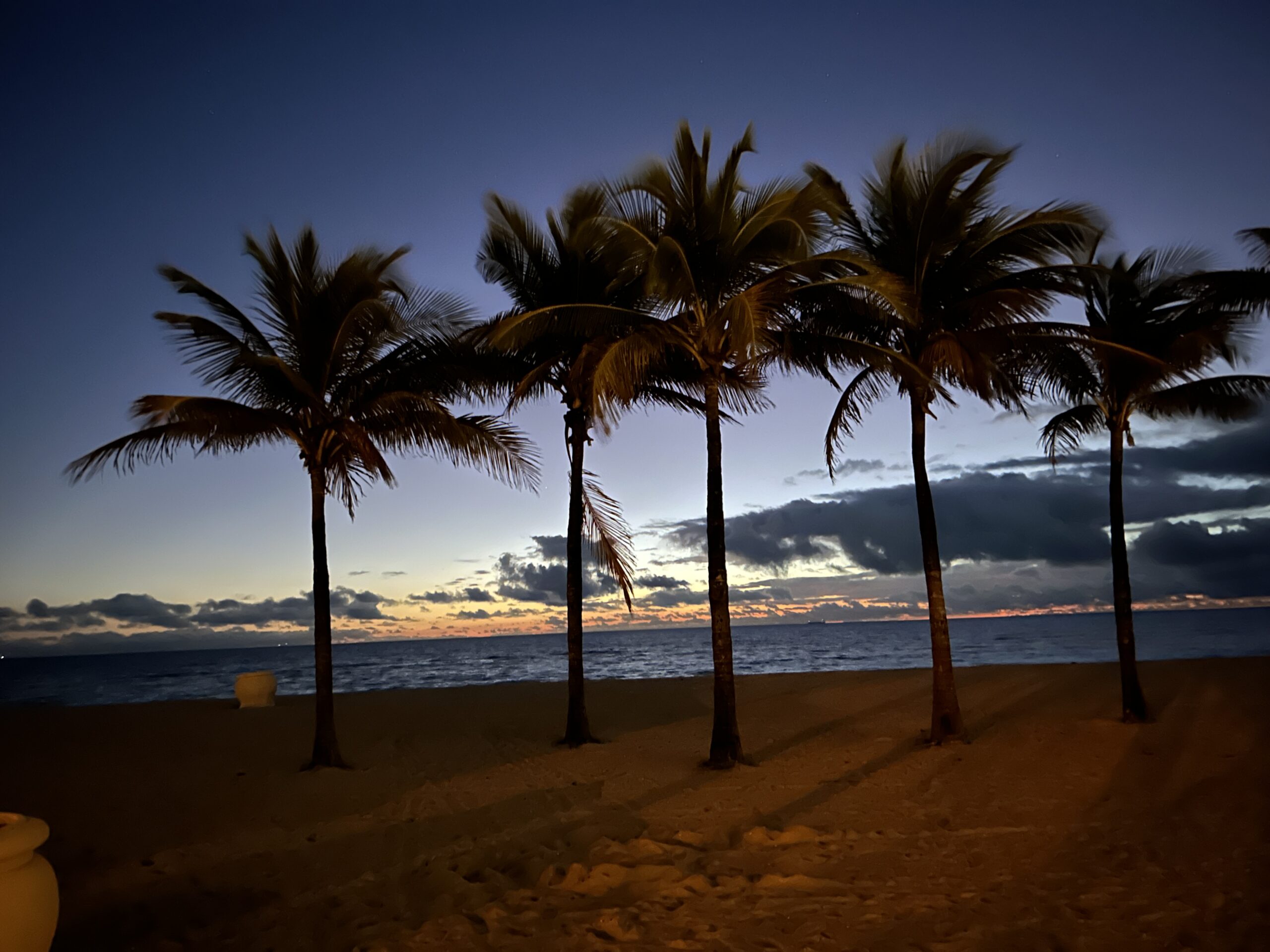
I grew up in Hollywood, Florida, a city about halfway between Miami and Fort Lauderdale on Florida’s east coast.
Its best feature was – and is – its beach. Unlike so much of the state’s coast, it’s not a “Condo Canyon,” lined by hi-rises. Instead, most of the buildings are smaller, 1- to 3-story homes or motels along with some open spaces. The rare exception is the behemoth “Margaritaville.” But, at least, its main building is set further back from the beach.
I hadn’t been down there in more than 9 years, so I was long overdue for a visit. I maximized the good stuff – booked a room at one of those small beachside motels and spent most of the trip on the beach. Also got to visit with old friends and with my brother.
So many things have changed:
Parlez-vous français? Non, apparently
This trip, I saw only one sign in French (and it was accompanied by English and Spanish).
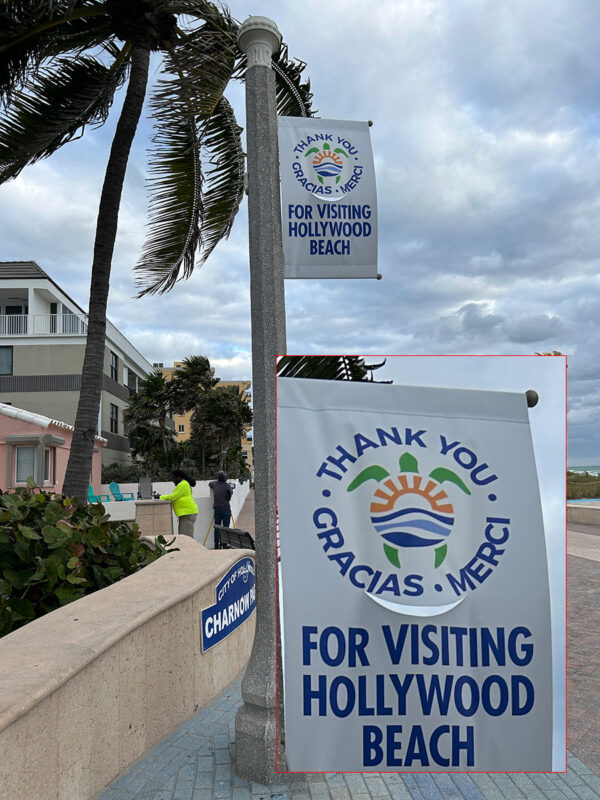
That’s a major change in the flavor of my hometown.
When I lived there, Hollywood attracted thousands of French Canadians to spend the winter on the beach. That meant loads of Quebec license plates. And lots of signs in shops and restaurants that read, “parlez-vous français.” I remember store announcements spoken in English, then French.
Gone.
Perhaps today’s French Canadians prefer other places to escape the cold. Or, perhaps, the hostility to foreigners from members of the current federal government has made Hollywood – and other American locations – less desirable.
The paddleball courts remain!
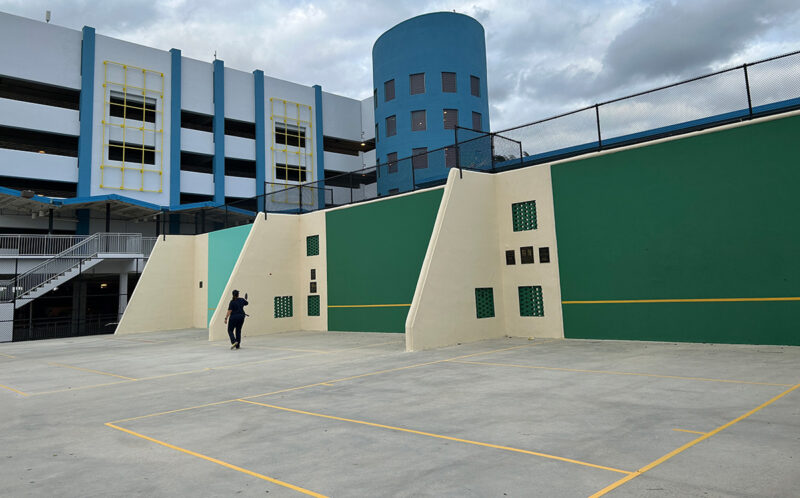
Paddleball was a popular sport where I grew up. Boys often cut their own paddles in shop class (we girls weren’t allowed to take shop, of course; I bought my paddle at a local sports store). My elementary school had paddleboard courts.
The game is played on a court designed as above, using a solid wood paddle (sometimes with drilled holes) and a small pink ball. Kinda like something between handball and raquetball, I guess.
The courts along Hollywood Beach were always busy. I was glad to see they’re still there and well-maintained. (The lack of players in the pic is due to it being early and rainy). Nice that no one’s tried to change them to pickleball.
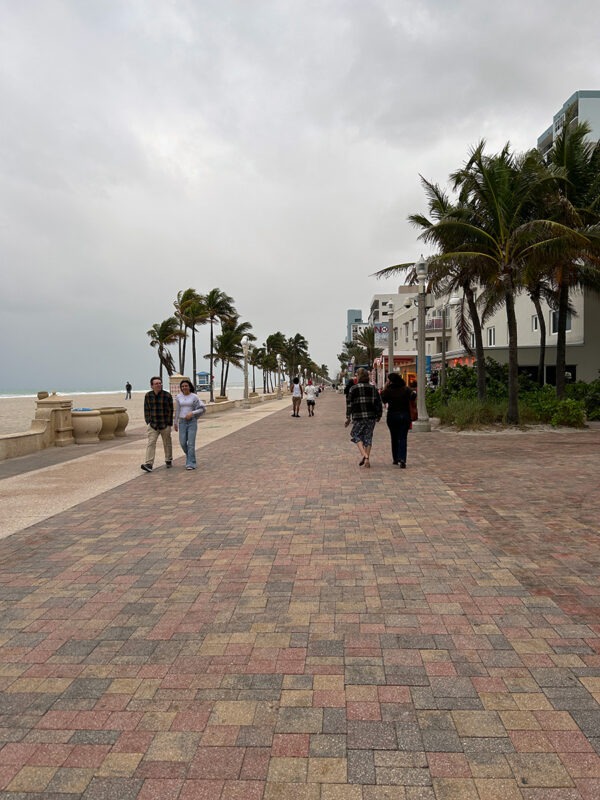
Ahhh: The Broadwalk
It’s prettier than ever: Flat, wide, with a special lane for bicyclists. Plenty of room to stroll or pedal up and down, or to sit and watch others stroll or pedal up and down. The brick-paved route is about 2 1/2 miles long, stretching from south of Hollywood Boulevard to the less-developed North Beach Park off Sheridan Street.
The Beach Theater is still at the Broadwalk and Johnson Street. A lot has changed around it: The rows of seats are gone. And the musical options are very different than when I was kid: back then, we got nothing more radical than “Hal Rader and his Men of Melody.” Lawrence Welk was more edgy.
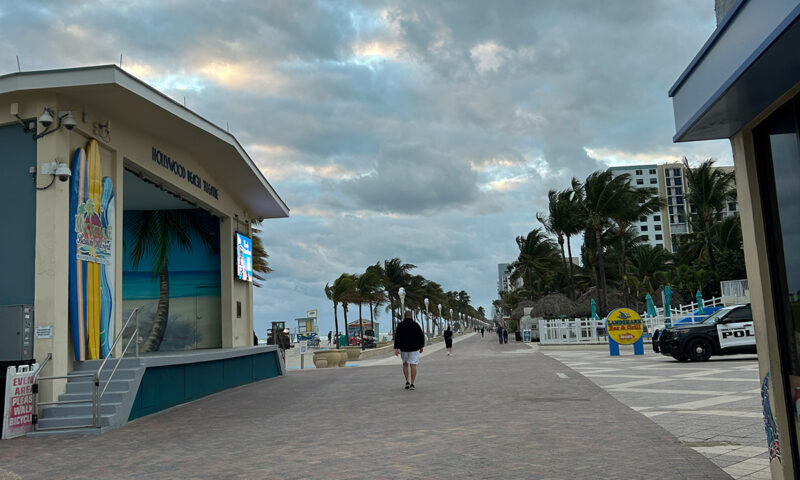
I spent a lot of my youth near that bandshell, playing guitar with others. We didn’t dare try to play on the stage; we’d be chased away.
I don’t remember lots of police vehicles on Hollywood Beach. This time, I saw them all over. All were empty.
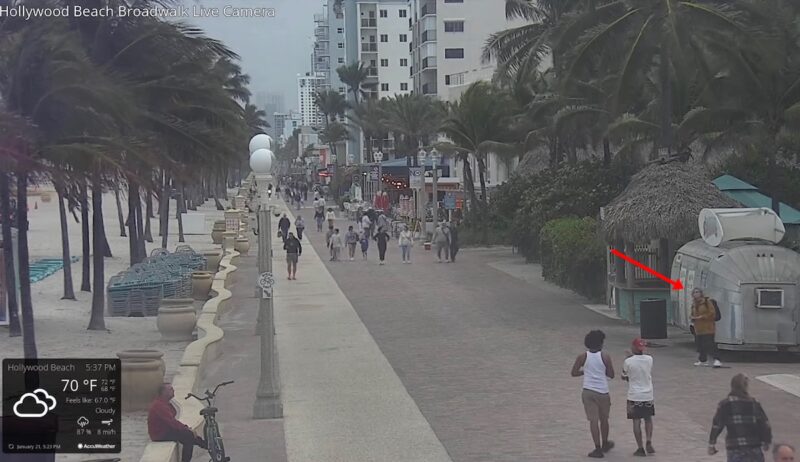
One last Broadwalk pic for you. There’s a live webcam of the beach, which I followed in the days before my trip. Once I was there, I stood at one of its locations and awaited my appearance. There I am!
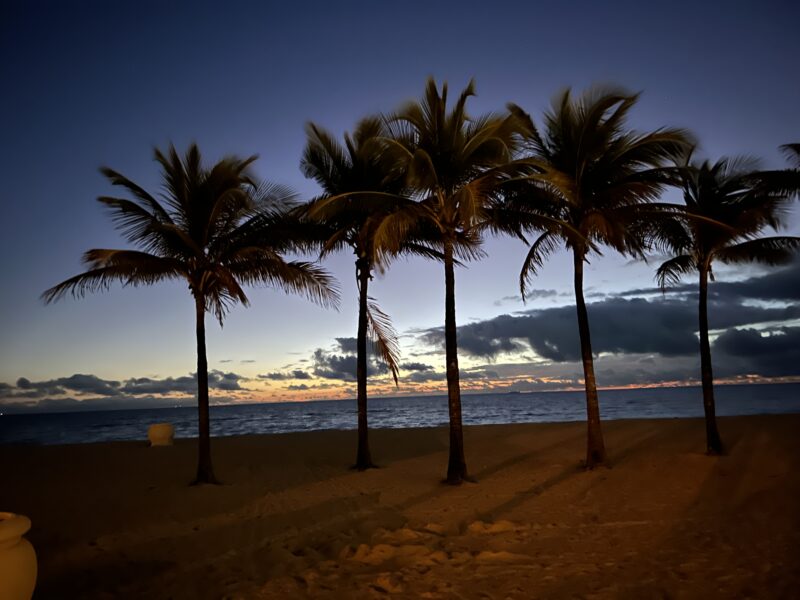
It’s still beautiful
The wind, clouds and rain didn’t go away until the morning I was leaving. But I did get this pretty peek at the sunrise.
Hollywood Beach is a smooth, wide, white-sand beach. Not exactly a natural area: They regularly have to truck in fresh sand. And the palms aren’t native as well. But, I believe, they’ve been there as long as Hollywood has.
The city was incorporated in 1925 and was largely created by an ambitious property developer, Joseph C. Young. He did very well, like other land barons in Florida of the time. The Great Hurricane of 1926, followed by the Great Depression, stopped all the wealth-building. But Hollywood survived.
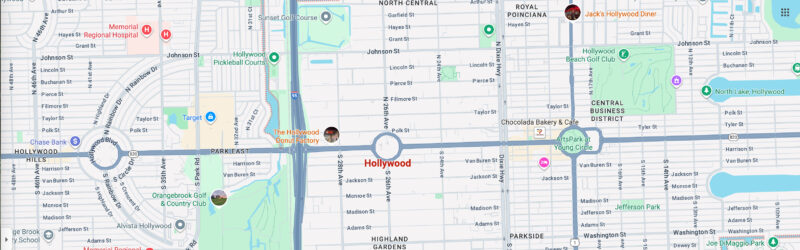
I like the way the city was designed: The main street, Hollywood Boulevard, features three circles, each with its own character. Nearly all of the streets parallel to the boulevard were named after U.S. Presidents. That taught me the names of the presidents, in order.
But, they ran out of presidents before they ran out of streets to name (the last president’s street is Warren Harding; Calvin Coolidge in some spots).
Unfortunately they filled in with the names of Confederate generals. Fortunately, that was corrected just a few years ago.
I also find it notable that the second key street was set up to be Johnson Street – not Lincoln Street, just a block south. I can’t help but think that came about via similar reasoning in the 1920s.