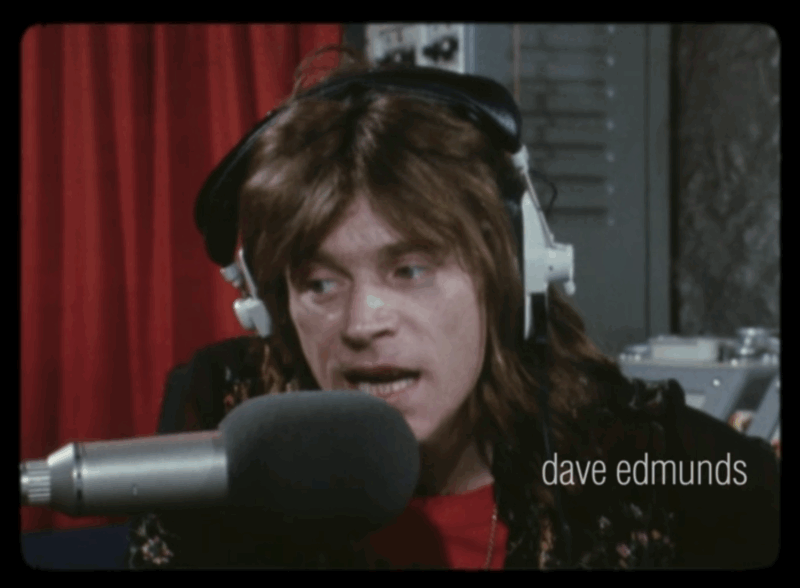
Dave Edmunds didn’t invent rock ‘n’ roll.
But he studied it. Absorbed it. Made it part of his very being.
And, once he blended it with his own unique style, Dave Edmunds made rock ‘n’ roll better.
An original, even when he copied someone
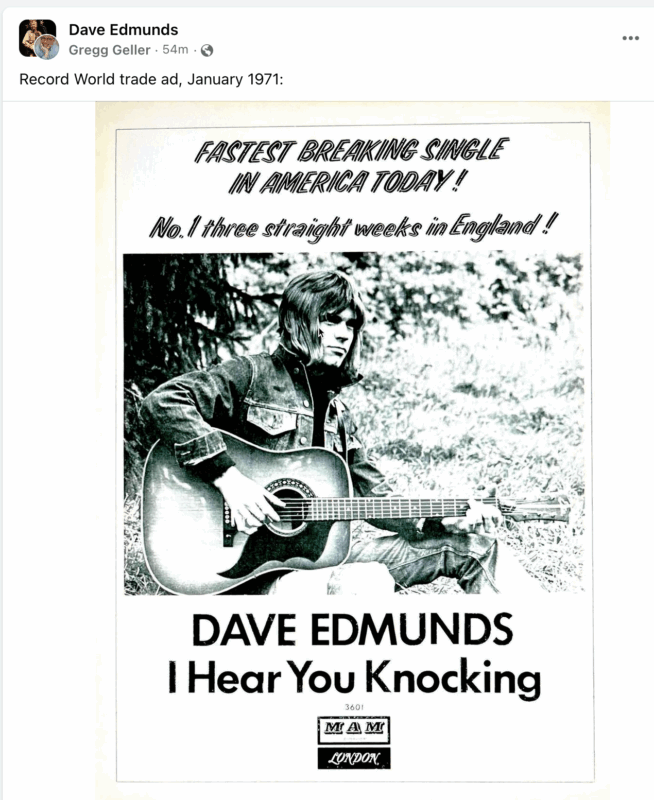
Despite 50 years in the music biz, Dave was very good at staying out of the public eye.
“I’m not in show business. I don’t have a manager, an agent or a publicist,” he said in a rare 1973 interview at Rockfield. “I just stay (in the studio) and make records.”
His biggest hit was his first one: “I Hear You Knocking,” in 1970. 1
He retired in 2017, but has left us with a wondrous legacy of music.
What. A. Voice
Dave Edmunds was a breathtaking singer, easily one of rock’s best. He could slide from a low growl to a sweet pop sound – even in the same song.
His voice was strong, assured, wild when needed, heartbreaking when the song demanded it.
Dave was a good mimic when he wanted to be. But in his best work, he used that talent merely as a starting point. When he sang, you know he loved Jerry Lee Lewis and George Jones. But he always sounded like … Dave Edmunds.
A premier song stylist and musician
Dave wasn’t primarily a songwriter. But he could take a tune written by someone else and make it his own.
Many of his choices were lesser-known songs – a Cliff Richard b-side, an oldie that wasn’t a hit its first time out.
He also benefitted from well-known artists who happily sent him songs, including Bruce Springsteen and Elvis Costello. 2
As a guitar player Dave mastered whatever style he put his mind to: the rockabilly twang, the power pop chime, the bluesy bend. Dark and light. 3
Early in his career, he fooled around with high-octane performances of classical compositions (his best-known was Khachaturian’s “Sabre Dance,” though I preferred his take on Bizet’s “Farandole”). Later on, he explored Chet Atkins-style fingerpicking and instrumental arrangements of pop classics.4
Dave also taught himself to play drums. And piano. And sax. And bass.
His “school” was Rockfield, a studio set up on a farm in south Wales. He’d go in there for hours and hours, learning how to overdub his own voice and instruments. How to engineer them to sound the way he wanted.
His expertise soon made him the go-to man if you needed a recording that perfectly captured the style of rockabilly or early ’60s pop or mid-’60s pop or whatever you needed. He served as “musical director” on movies and special concerts. He even ended up with a movie role in the 1974 melodrama “Stardust” (Dave did the music for it, too).
These talents and skills led Dave to a second career as a producer. Artists he worked with were rewarded with perfect drum sounds (oh, he made the snare drum count). Bright acoustic rhythm guitars. And, of course, spot-on vocals and the best electric guitar tones.
Just a partial list of artists produced by Dave Edmunds:
- The Stray Cats
- Foghat
- Flamin’ Groovies
- k.d. Lang
- The Everly Brothers
- The Fabulous Thunderbirds
- Status Quo
- Nick Lowe
The magic of Rockpile
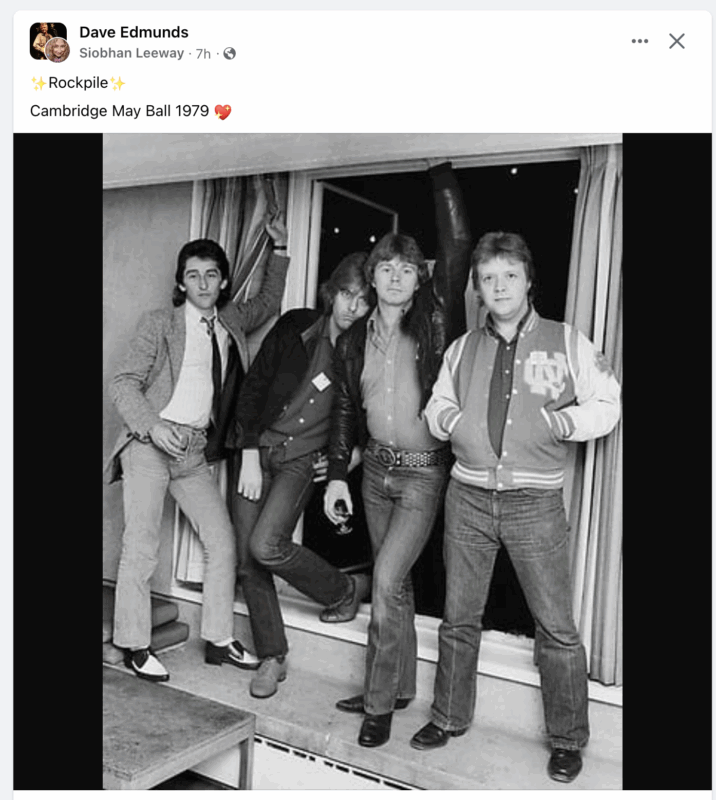
Dave’s musical peak came with his four albums on Led Zeppelin’s label, Swan Song. This was also when Dave developed the definitive lineup of the band Rockpile: guitarist Billy Bremner, drummer Terry Williams and bassist/songwriter/foil Nick Lowe.
The quartet played on most of the tracks of the Swan Song albums, touring between releases. They also played on Nick Lowe’s “solo” albums of the time, particularly “Labour of Lust” (home of his hit, “Cruel to Be Kind”).
There’s a wonderful UK documentary, “Born Fighters,” that follows Rockpile as they recorded Lowe’s “Labor of Lust” and Dave’s “Repeat When Necessary.” It perfectly captures the dynamics of the band, from spotlighting each member’s contribution to revealing just how much each of them was drinking at the time.
Go listen to these albums!
Get It (1977): a mix of DIY Edmunds and some embryonic Rockpile. Nick Lowe’s brilliant “I Knew the Bride” is here, with a solo Dave vocal (though the song was at its best live, when Dave and Nick sang in harmony). Other highlights are “Let’s Talk About Us” and Bob Seger’s “Get out of Denver.”
Tracks on Wax 4 (1978): If aliens landed on our planet and demanded to know what “rock music” is, play them this. The musical decisions Dave makes, for vocals / guitars / drums / piano / attitude – make every track shine. Dave even gets some co-songwriting credits here, usually a collaboration with Nick Lowe.
Highlights? All of them, but especially “Television” (ooooh, the vocals on the chorus), “Deborah” (Dave shows how sweet he can be) and “It’s My Own Business” (Dave shows how angry he can be).
Repeat When Necessary (1979): Reviewed well, somewhat commercially successful, it’s known for “Girls Talk” and “Crawling From The Wreckage” and “Sweet Little Lisa,” swinging rockers all. There’s also “Queen of Hearts,” where Dave creates a country ballad so sweet that singer Juice Newton scored a major hit by copying Dave’s arrangement exactly.
Twangin’ (1981). This is mostly a contractual-obligation album, with tracks that had been lying around. It sure doesn’t sound or feel like it, though, with fine tunes like “Something Happens” (John Hiatt!), “Cheap Talk, Patter and Jive” (worth it just to hear Welshman Edmunds pronounce “jive”) and the rockabilly perfection of Dave’s cover of George Jone’s “The Race is On” – backed by his proteges the Stray Cats.
Dave made records before and after Swan Song. Good records. But, oh, these four.
Somehow, Dave’s penchant for precision – especially in the studio – blended nicely with Rockpile’s far freer (anarchic?) approach to playing.
They recorded only one album under the group name – “Seconds of Pleasure.” It was OK. The group toured it in 1980 – and broke up shortly after.
Movie soundtracks, famous tours
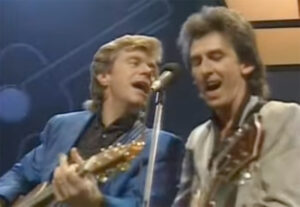
Post-Rockpile, Dave played a lot: Movie soundtracks, tours with his own band or with people like Dion and Ringo Starr. He played a big part in the mid-1980s reunion of the Everly Brothers. He joined a 1985 tribute to Carl Perkins with George Harrison, Ringo Starr and Eric Clapton.
In 1990, he was musical director of a John Lennon tribute concert. In Liverpool, no less.
And Dave was a regular at the jam sessions that concluded each year’s Rock & Roll Hall of Fame induction show.
His last working years involved smaller tours of Britain and Europe, usually accompanied by musicians from Sweden. After years living in Los Angeles, he moved back to Wales.
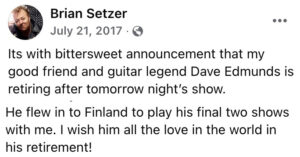
Dave never did announce his 2017 retirement. His old protege Brian Setzer of the Stray Cats did, in a Facebook post about his upcoming show. Dave joined Brian onstage for the milestone.
Not much has been heard from Dave since then. There were news stories when he auctioned off some guitars, particularly a Martin acoustic that had been a gift from Eric Clapton. Even then, Dave wasn’t the focus:
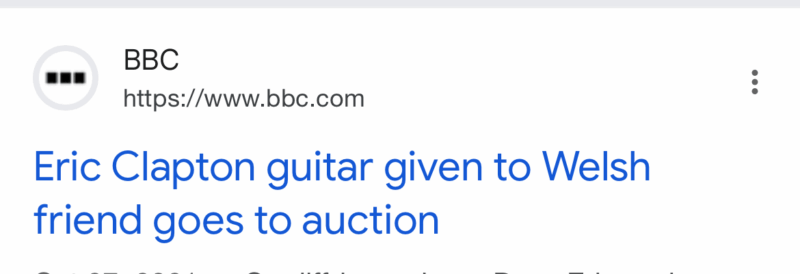
(The guitar sold for $625,000.)
Toward the end of July 2025, Dave’s wife Cici made a highly emotional post on social media, saying her husband “had a major cardiac arrest.” A few days later, Dave’s friend and singing partner Carlene Carter reported that Dave was improving and “would be out of the hospital soon.”
Dave is 81 years old. He already had heart surgery back in the 1990s.
Fortunately, his music is still there to enjoy. If ever I need a smile on my face, I put on music by Dave Edmunds.
Thank you, Dave.
Why I wrote this
It was summer, 1979. I’d been writing a music column for five years5.
I went to see Dave and his band, Rockpile, opening for Blondie. I liked Blondie, but I was there for Rockpile.
Rockpile played for only 20 minutes. And, in that brief time, Dave and his guys reinforced why I loved music, why I gravitated to rock ‘n’ roll. And why Dave was better at it than anyone else.
I got to hear Dave live two more times – the 1980 Rockpile “Seconds of Pleasure” tour, then – 21 years later! – an amazing performance by Dave, alone, playing whatever he felt like on acoustic guitar: “Blue Moon of Kentucky,” “Men of Harlech,” “Classical Gas,” “I Knew the Bride.”
I’ve burned through several vinyl copies of Dave’s albums. Got them on CD. Still listen to him. A lot.
And, every time, he reminds me of the joys of music. And his particular take on it.
Notes
1 No less than John Lennon was a massive fan of “I Hear You Knocking,” mentioning it and Dave several times in his extensive 1971 interview for Rolling Stone magazine.
2 Springsteen invited Dave backstage at his Wembley concert to give Dave his “From Small Things, Big Things Come.” Elvis Costello gave him the early demo of “Girls Talk,” which Dave turned from a somewhat contemplative tune to a shiny rocker.
3 Early in his career, Dave’s record company recommended he make a blues album. “What’s blues?” he responded. He caught on quick. His ’60s band Love Sculpture released “Blues Helping” and, while it is far from Edmunds’ best work, it’s no worse than the efforts of other British musicians of the era.
4 Dave’s acting role in “Stardust” is pretty tiny. His only line is to tell David Essex to “piss off.” He appeared in another, truly dire, movie: 1984’s “Give My Regards to Broad Street,” written by and starring Paul McCartney. It makes about as much sense as McCartney’s previous cinematic project, “Magical Mystery Tour.”
5 I retired the music column in 1986. It was a good run.
Selected Discography
TK
More links
TK