
M. Leslie Wimmer was a major force in the South Florida music scene of the 1980s.
Leslie operated Open Books & Records, first in Fort Lauderdale, then in North Miami Beach. Thanks to her open heart, many a music fan got to hear sounds not offered by local radio or mainstream media. Area musicians had a place to sell their records – hell, Leslie helped release a lot of them.
Charlie Pickett’s remembrance is worth reading: https://www.facebook.com/charlie.pickett.79/posts/pfbid028vMWAqUvTiJVxwkvd3AxPxurdtnyJybdWCkCGAk9TYXpvmDsCzd6ejJa2ecVgEdgl
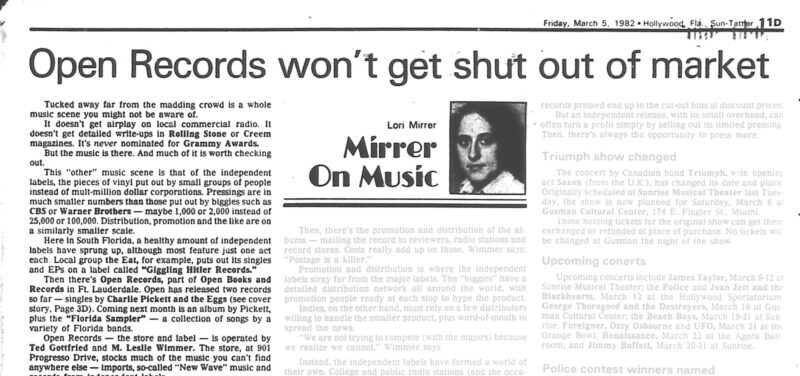
I don’t know if I have it in me to write a proper remembrance. In the meantime, below is the text of what I wrote about Open Books & Records back in 1982.
Tucked away far from the madding crowd is a whole music scene you might not be aware of.
It doesn’t get airplay on local commercial radio. It doesn’t get detailed write-ups in Rolling Stone or Creem magazines. It’s never nominated for Grammy Awards.
But the music is there. And much of it is worth checking out.
This “other” music scene is that of the independent labels, the pieces of vinyl put out by small groups of people instead of mult-million dollar corporations. Pressings are in much smaller numbers than those put out by biggies such as CBS or Warner Brothers — maybe 1,000 or 2,000 instead of 25,000 or 100,000. Distribution, promotion and the like are on a similarly smaller scale.
Here in South Florida, a healthy amount of independent labels have sprung up, although most feature just one act each. Local group the Eat, for example, puts out its singles and EPs on a label called “Giggling Hitler Records.”
Then there’s Open Records, part of Open Books and Records in Ft. Lauderdale. Open has released two records so far — singles by Charlie Pickett and the Eggs (see cover story, Page 3D). Coming next month is an album by Pickett, plus the “Florida Sampler” – a collection of songs by a variety of Florida bands.
Open Records – the store and label — is operated by Ted Gottfried and M. Leslie Wimmer. The store, at 901 Progresso Drive, stocks much of the music you can’t find anywhere else — Imports, so-called “New Wave” music and records from independent labels.
The label is attempting to present a similarly esoteric selection.
Wimmer says founding your own label is “so simple. You decide what your name is going to be, then check with ASCAP and BMI (music licensers) to make sure no one else has the name.”
No one else had registered Open Records, so Wimmer and Gottfried did so. Then there’s forms to fill out and send to the U.S. copyright office. And, your label is started.
Wimmer says that Open Records started out as a “mutual deal” between Charlie Pickett and the store. “He wanted a distributor (for his singles) and we wanted to put vinyl out,” she says.
Pickett’s first single, “Feelin'” b/w (backed with; i.e., flip side) “White Light White Heat,” came out early last year. The pressing of 1,000 sold well. A second Pickett single, “If This Is Love” b/w “Slow Death,” sold out its 1,000 pressing. An additional 500 were pressed.
The next Open release with be Pickett’s live at the Button LP. There will be around 2,000 of those pressed.
Then, there’s Open’s “Florida Sampler” LP. The material will be chosen from among the 50 tapes solicited by Open from any Florida band that chose to enter. There will be 2,000 “Florida Sampler” LPs pressed as well.
The cost of making an album runs at least $3,000, Wim-mer says. The components of the record itself – laquers, test pressings and the mold for the final pressings – cost about $1,900. The color cover costs about another $1,000.
Then, there’s the promotion and distribution of the albums — mailing the record to reviewers, radio stations and record stores. Costs really add up on those, Wimmer says:
“Postage is a killer.”
Promotion and distribution is where the independent labels stray far from the major labels. The “biggies” have a detailed distribution network all around the world, with promotion people ready at each stop to hype the product.
Indies, on the other hand, must rely on a few distributors willing to handle the smaller product, plus word-of-mouth to spread the news.
“We are not trying to compete (with the majors) because we realize we cannot,” Wimmer says.
Instead, the independent labels have formed a world of their own. College and public radio stations (and the occasional adventurous commercial station, such as Jupiter’s WCEZ-FM) are willing to play independent records. Rock-/dance clubs across the country put the discs on. Stores such as Open Records are willing to accept the records, on consignment, and play them for interested customers. And alternative music publications such as New York’s Rocker Magazine, Trouser Press, Washington, D.C.’s OP and the Lost Music Network, write about the independent records.
While independents have made themselves a small foothold in the United States, such labels are commonplace hitmakers in Great Britain. Labels such as Stiff Records, F-Beat and 2-Tone in Britain regularly make the top of the charts in the U.K. American independents also get a listen there.
“There is no distribution network comparable to it in the States,” Wimmer laments.
But independent releases and artists still have a chance to be heard in the U.S. Open’s releases by Pickett are on sale all across the country, plus in countries such as England and Germany. A planned Pickett tour of the East Coast should aid recognition – and sales.
There is one thing independent labels have over the big companies — the easier chance of turning a profit. Due to the large overhead of a big label, a new album must sell anywhere from 50,000 to 250,000 (halfway to a Gold Record award) in order to make back its costs. When that doesn’t happen, as is often, the big label loses money and the excess records pressed end up in the cut-out bins at discount prices.
But an independent release, with its small overhead, can often turn a profit simply by selling out its limited pressing.
Then, there’s always the opportunity to press more.